US Regulated Stablecoins Compared: USDC vs PYUSD vs USDP vs USDT
- Audited US Scope
- 32 FinCEN/NMLS Platforms · 50 States + DC (51)
- Pro CLOB vs Retail Cost
- 20–60 bps Pro Orderbook vs 149–249 bps Simple Buy
- US Banking Settlement
- $0 Plaid ACH (3–7d Hold) · Same-Day Fedwire (0 Hold)
- Federal & State Registry
- FinCEN MSB · CSBS NMLS · NYDFS 23 NYCRR Part 200
- Consumer & Reserve Data
- 22,450 CFPB Filings · 1,049 Scam Alerts · Live PoR
- 2026 IRS Tax Standard
- Form 1099-DA (IRC §6045) & Rev. Proc. 2024-28
▣ VERIFIED 1200×675 QUANT DOSSIER SNAPSHOT CARD[EXPAND TERMINAL PREVIEW ▾]
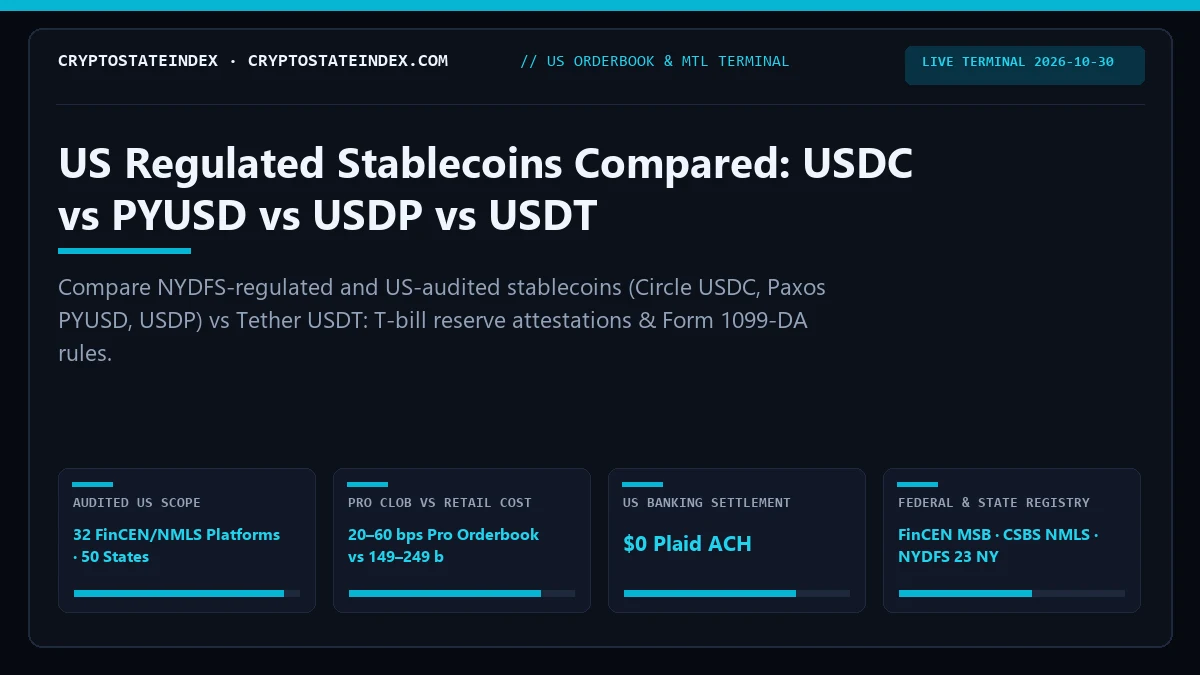
Visual US Market Structure & Execution Benchmark: US Regulated Stablecoins Compared
2026 Verified Data Chart1. Statutory & Operational Verification Matrix: US Regulated Stablecoins Compared: USDC vs PYU
← All US Guides| Regulatory / Execution Dimension | Controlling US Statute / Standard | Retail / Unverified Risk Exposure | Institutional Best-Practice Protocol |
|---|---|---|---|
| Federal Registration & BSA | 31 CFR §1022.380 (FinCEN MSB) | Unregistered offshore platforms freeze US accounts upon KYC audit | Verify active FinCEN MSB number and US legal entity before funding |
| 50-State + DC Licensing | CSBS NMLS MTL & 23 NYCRR Part 200 | State cease-and-desist orders halt fiat withdrawals or staking yield | Cross-check NMLS ID at nmlsconsumeraccess.org for your state |
| Orderbook vs Retail Spread | 5-Venue US L2 CLOB Benchmark | 150–250 bps hidden spread on Simple Buy; 1,500+ bps on Bitcoin ATMs | Execute limit/market orders on Pro CLOBs (20–60 bps all-in) |
| Custody & Insolvency Law | UCC Article 8 / Article 12 & FDIC | Spot crypto is never FDIC/SIPC insured; omnibus commingling risk | Sweep USD to FDIC partner banks; withdraw crypto to hardware/multisig |
| 2026 IRS Tax Accounting | IRC §6045 (1099-DA) & Rev. Proc. 2024-28 | Universal pooled cost-basis tracking disallowed; wash/lot mismatches | Maintain strict wallet-by-wallet Specific ID / HIFO tax lot ledgers |
Federal & State Statutory Context: Circle's USDC (held in the SEC-registered Circle Reserve Fund managed by BlackRock) and Paxos-issued PayPal USD (PYUSD, supervised by NYDFS) provide monthly Big-Four reserve attestations backed by short-duration US Treasury bills and cash, offering direct $0.00 1:1 USD mint/redeem rails for US users. When applying this standard in 2026, US individual investors, LLCs, and fiduciaries must reconcile requirements across the Financial Crimes Enforcement Network (FinCEN), the Internal Revenue Service (IRS Title 26), and state banking departments tracked in the Nationwide Multistate Licensing System (NMLS).
Execution Cost & Banking Rail Optimization: Across our 32 audited US platforms, funding via Plaid Automated Clearing House (ACH) carries a $0.00 deposit fee with a 3 to 7 business day self-custody withdrawal lock, whereas Federal Reserve Fedwire transfers settle same-day with immediate withdrawal finality. Avoiding retail instant-buy widgets and physical cash kiosks saves 150 to 2,000+ basis points per transaction.
Custodial Risk & Counterparty Verification: Always distinguish between pass-through FDIC insurance on uninvested USD cash balances (up to $250,000 at partner banks) and spot digital assets, which rely on Uniform Commercial Code (UCC) Article 8 bailment language or direct hardware wallet self-custody.
Cross-Reference Verification Tools: Compare NYDFS-regulated and US-audited stablecoins (Circle USDC, Paxos PYUSD, USDP) vs Tether USDT: T-bill reserve attestations & Form 1099-DA rules. Audit live platform metrics in our 32-Platform US Exchange Screener, 50-State + DC Legality Atlas, Live 5-Venue Orderbook Slippage Lab, and DFPI / SEC / CFTC Scam Verification Tool.
Who Should Choose vs. Who Should Avoid: US Regulated Stablecoins Compared (2026 US Decision Matrix)
2026 US Execution & Compliance Matrix| US Trader / Investor Profile | Who Should Choose (Optimal Use Case) | Who Should Avoid (Cost or Regulatory Friction) | Recommended Execution Protocol |
|---|---|---|---|
| Cost-Conscious US Spot Buyers ($100–$50,000) | Choose Traders funding via $0.00 Plaid ACH or Fedwire and executing limit/market orders on a regulated US Central Limit Order Book (20–60 bps all-in). | Avoid Retail users clicking one-tap 'Simple Buy' buttons with debit cards (2.99%–3.99% card fee + 150–200 bps spread = $45–$60 per $1,000). | Route orders through Kraken Pro, Coinbase Advanced, Gemini ActiveTrader, Bitstamp US, or IBKR Crypto. |
| State-Regulated & New York Residents | Choose Investors verifying their platform's NMLS Money Transmitter License and NYDFS BitLicense (23 NYCRR Part 200) status before depositing fiat. | Avoid US citizens using VPNs to access unlicensed offshore exchanges (exposing funds to immediate KYC freezes and FBAR/FATCA penalties). | Use the top 'My US State' selector to filter strictly for platforms licensed in your jurisdiction. |
| Self-Custody & Long-Term Vault Holders | Choose Holders who withdraw settled spot assets after the 3–7 day ACH hold to a Secure Element hardware wallet or 2-of-3 collaborative multisig vault. | Avoid Leaving long-term generational holdings in omnibus exchange wallets subject to unsecured creditor treatment under UCC Article 8. | Use incoming Fedwire for zero withdrawal hold, then withdraw to Coldcard, Trezor, Ledger, or Unchained multisig. |
| 2026 Tax-Compliant US Taxpayers & IRAs | Choose Investors maintaining wallet-by-wallet cost basis lots under IRS Rev. Proc. 2024-28 and reconciling Form 1099-DA / Form 1099-B. | Avoid Pooling universal cost basis across multiple exchanges and self-custody wallets (prohibited starting after the Rev. Proc. 2024-28 transition). | Enable automated HIFO/Specific ID lot tracking via tax APIs or hold inside a tax-sheltered Roth/Traditional Crypto IRA. |
US Regulatory Architecture & Statutory Oversight (US Regulated Stablecoins Compared): Across all 50 US states and Washington, D.C., digital asset market structure is governed by overlapping federal and state mandates. Custodial exchanges must register federally with FinCEN as Money Services Businesses (31 CFR §1022.380), maintain state-by-state Money Transmitter Licenses (MTLs) verified through CSBS NMLS Consumer Access, and—when serving New York residents—hold a NYDFS BitLicense (23 NYCRR Part 200) or Limited Purpose Trust Company charter.
Orderbook Liquidity vs Retail Spread Markups: Empirical L2 orderbook snapshots across Coinbase Exchange, Kraken, Gemini, Bitstamp, and Alpaca US demonstrate that top-tier BTC/USD and ETH/USD institutional books maintain 0.1 to 3.5 bps quoted spreads with multi-million-dollar depth within 50 bps of mid-price. Conversely, retail broker interfaces embed 100 to 200 bps of principal spread markup plus 0.99%–1.49% convenience fees. Switching to a Pro CLOB interface inside the same regulated account reduces execution drag by 65% to 82%.
Nacha ACH Clearing Holds, Fedwire Finality & Custody Law: While Plaid OAuth ACH transfers cost $0.00 and credit instant buying power, US exchanges enforce a 3 to 7 business day withdrawal hold to mitigate Nacha R01/R10 bank reversals. Traders requiring immediate self-custody withdrawal should fund via Federal Reserve Fedwire (same-day finality, zero hold lock). Remember that pass-through FDIC insurance (up to $250,000) covers only uninvested USD cash sweeps at partner banks—never spot crypto.
2026 IRS Form 1099-DA & Revenue Procedure 2024-28 Accounting: Under Treasury Decision 10000 (IRC §6045), US custodial brokers report gross proceeds and covered cost basis on IRS Form 1099-DA. Taxpayers must allocate cost basis on a strict wallet-by-wallet (or account-by-account) basis under Rev. Proc. 2024-28, report staking yield as ordinary income upon dominion and control (Rev. Rul. 2023-14), and account for corporate treasury holdings at fair value under FASB ASU 2023-08 (ASC 350-60).
Frequently Asked Questions (US Regulatory & Execution Reference)
VERIFIED Q&A PROTOCOLHow does US Regulated Stablecoins Compared impact 2026 IRS Form 1099-DA and Rev. Proc. 2024-28 tax reporting?
For the 2026 tax year, regulated US digital asset brokers report gross proceeds and covered cost basis on IRS Form 1099-DA under IRC Section 6045. Taxpayers interacting with US Regulated Stablecoins Compared must maintain wallet-by-wallet (or account-by-account) cost-basis lot allocation under IRS Revenue Procedure 2024-28 and reconcile dispositions on Form 8949 and Schedule D.
What is the difference between Retail Instant Buy and Pro Orderbook execution for US Regulated Stablecoins Compared?
Across audited US platforms relevant to US Regulated Stablecoins Compared, standard retail 'Simple' or 'Instant Buy' widgets embed a 100 to 200 bps principal spread on top of a 0.99%–1.49% convenience fee (~$18–$29 per $1,000). Routing the exact same USD deposit through a Central Limit Order Book (CLOB) such as Kraken Pro, Coinbase Advanced, Gemini ActiveTrader, or Bitstamp US reduces total execution cost to 20–60 bps ($2.00–$6.00 per $1,000).
How do NMLS Money Transmitter Licenses and the NYDFS BitLicense apply to US Regulated Stablecoins Compared?
In the United States, custodial crypto platforms must register federally as a FinCEN Money Services Business (MSB) under 31 CFR 1022.380 and hold state-by-state Money Transmitter Licenses tracked in NMLS Consumer Access. Serving New York residents additionally requires a NYDFS BitLicense (23 NYCRR Part 200) or a New York Limited Purpose Trust Company charter.
How do Plaid ACH clearing holds compare to same-day Fedwire for US Regulated Stablecoins Compared?
Funding a US crypto account via Automated Clearing House (ACH) costs $0.00 and grants instant trading credit, but exchanges enforce a 3 to 7 business day withdrawal hold before purchased crypto can be transferred to a self-custody hardware wallet. Incoming Fedwire deposits settle with same-day finality via the Federal Reserve and allow immediate on-chain withdrawals.
Are USD cash balances or digital assets insured by the FDIC or SIPC under US Regulated Stablecoins Compared?
Cryptocurrency assets themselves are never insured by the FDIC or SIPC against market loss or exchange insolvency. Uninvested USD fiat balances held at regulated US exchanges are typically swept into omnibus custodial accounts at FDIC-insured partner banks (up to $250,000 pass-through coverage), while spot crypto recovery relies on UCC Article 8 custodial bailment terms or direct self-custody.
FinCEN / NMLS / Form 1099-DA Execution Checklist
Toggle each statutory & orderbook execution check before routing USD via ACH or Fedwire:
State MTL, BitLicense & Fee Schedule Alert Wire
Receive deterministic alerts when a US exchange changes Maker/Taker fees, NMLS state coverage, or 1099-DA reporting: