US Crypto Market Structure, Regulatory Verification & Tax Reference Guides
- Audited US Scope
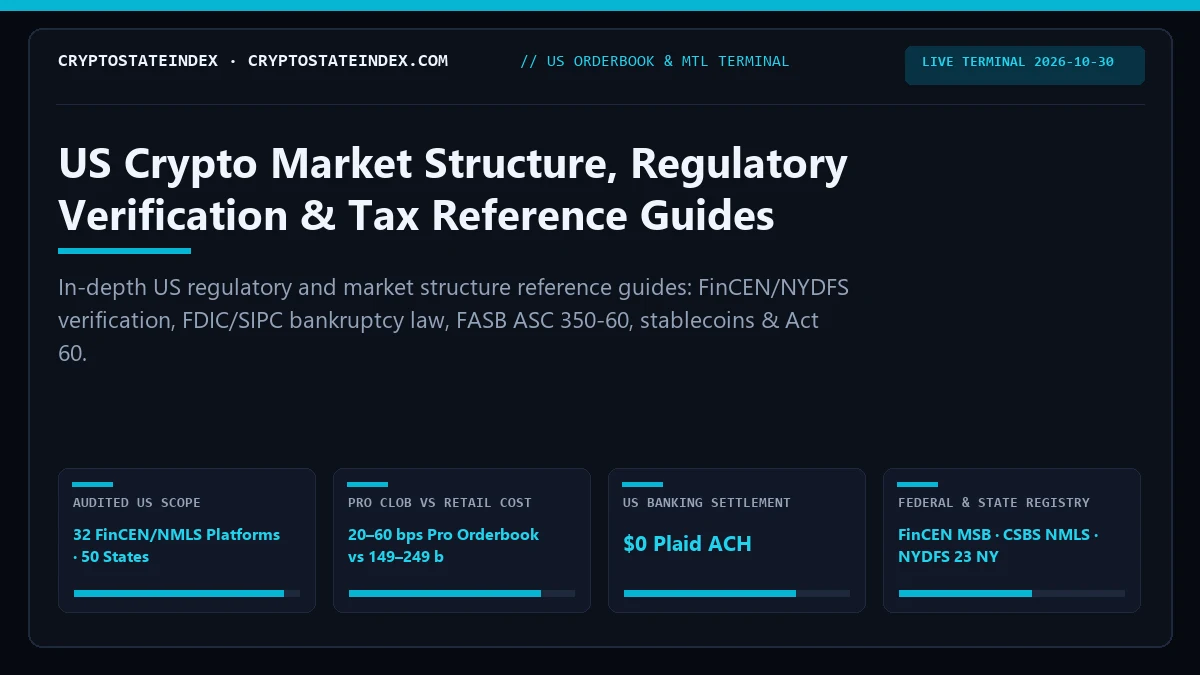
- 32 FinCEN/NMLS Platforms · 50 States + DC (51)
- Pro CLOB vs Retail Cost
- 20–60 bps Pro Orderbook vs 149–249 bps Simple Buy
- US Banking Settlement
- $0 Plaid ACH (3–7d Hold) · Same-Day Fedwire (0 Hold)
- Federal & State Registry
- FinCEN MSB · CSBS NMLS · NYDFS 23 NYCRR Part 200
- Consumer & Reserve Data
- 22,450 CFPB Filings · 1,049 Scam Alerts · Live PoR
- 2026 IRS Tax Standard
- Form 1099-DA (IRC §6045) & Rev. Proc. 2024-28
▣ VERIFIED 1200×675 QUANT DOSSIER SNAPSHOT CARD[EXPAND TERMINAL PREVIEW ▾]
Visual US Market Structure & Execution Benchmark: US Crypto Market Structure, Regulation, Tax Guides (2026)
2026 Verified Data Chart| Reference Briefing | Coverage |
|---|---|
| How to Verify FinCEN MSB, NMLS ID & NYDFS BitLicense Status | Step-by-step guide to verifying any crypto exchange's FinCEN Money Services Business registration, NMLS Consumer Access record, and NYDFS BitLicense. |
| FDIC & SIPC Insurance vs UCC Article 8: Exchange Bankruptcy Rules | Understand pass-through FDIC insurance on USD cash sweeps ($250,000 limit), why crypto is never FDIC/SIPC insured, and UCC Article 8 custodian protections. |
| US Bitcoin ATM Fees (15%–25% Spread), State Caps & Fraud Rules | Audit of US Bitcoin ATM operators: 15%–25% retail spread markups, FinCEN $3,000/$10,000 CTR rules, and California $1,000/day statutory ATM caps. |
| Holding Bitcoin on a US LLC or Corporate Balance Sheet (FASB ASC 350-60) | Guide to US corporate Bitcoin treasury accounting under FASB ASU 2023-08 (ASC 350-60) fair-value reporting, FinCEN BOI rules, and institutional custody. |
| Can US Citizens Use Offshore Exchanges (Binance, Bybit, OKX) with a VPN? | Legal, tax, and account-freeze risks for US citizens using VPNs to access unregistered offshore crypto exchanges: FinCEN, CFTC, FBAR & FATCA rules. |
| US Regulated Stablecoins Compared: USDC vs PYUSD vs USDP vs USDT | Compare NYDFS-regulated and US-audited stablecoins (Circle USDC, Paxos PYUSD, USDP) vs Tether USDT: T-bill reserve attestations & Form 1099-DA rules. |
| Bitcoin & Crypto-Backed Loans in the US: Unchained, Ledn & Aave Tax Rules | Compare US Bitcoin-backed USD loans: collaborative multisig vs rehypothecated lenders, LTV liquidation thresholds, and why borrowing USD is not a taxable sale. |
| Best US Crypto Credit & Debit Cards: Gemini Card vs Coinbase Card vs Fold | Compare US crypto rewards credit and debit cards: Gemini Credit Card (instant crypto rewards), Fold Debit/Credit Card, and Coinbase Card tax rules. |
| Puerto Rico Act 60 Crypto Tax Rules: IRS Bona Fide Residency & Section 937 | Strict IRS Section 937 rules for US citizens moving to Puerto Rico under Act 60: 183-day presence test, closer connection, and pre-move crypto gains. |
Who Should Choose vs. Who Should Avoid: US Crypto Market Structure, Regulation, Tax Guides (2026) (2026 US Decision Matrix)
2026 US Execution & Compliance Matrix| US Trader / Investor Profile | Who Should Choose (Optimal Use Case) | Who Should Avoid (Cost or Regulatory Friction) | Recommended Execution Protocol |
|---|---|---|---|
| Cost-Conscious US Spot Buyers ($100–$50,000) | Choose Traders funding via $0.00 Plaid ACH or Fedwire and executing limit/market orders on a regulated US Central Limit Order Book (20–60 bps all-in). | Avoid Retail users clicking one-tap 'Simple Buy' buttons with debit cards (2.99%–3.99% card fee + 150–200 bps spread = $45–$60 per $1,000). | Route orders through Kraken Pro, Coinbase Advanced, Gemini ActiveTrader, Bitstamp US, or IBKR Crypto. |
| State-Regulated & New York Residents | Choose Investors verifying their platform's NMLS Money Transmitter License and NYDFS BitLicense (23 NYCRR Part 200) status before depositing fiat. | Avoid US citizens using VPNs to access unlicensed offshore exchanges (exposing funds to immediate KYC freezes and FBAR/FATCA penalties). | Use the top 'My US State' selector to filter strictly for platforms licensed in your jurisdiction. |
| Self-Custody & Long-Term Vault Holders | Choose Holders who withdraw settled spot assets after the 3–7 day ACH hold to a Secure Element hardware wallet or 2-of-3 collaborative multisig vault. | Avoid Leaving long-term generational holdings in omnibus exchange wallets subject to unsecured creditor treatment under UCC Article 8. | Use incoming Fedwire for zero withdrawal hold, then withdraw to Coldcard, Trezor, Ledger, or Unchained multisig. |
| 2026 Tax-Compliant US Taxpayers & IRAs | Choose Investors maintaining wallet-by-wallet cost basis lots under IRS Rev. Proc. 2024-28 and reconciling Form 1099-DA / Form 1099-B. | Avoid Pooling universal cost basis across multiple exchanges and self-custody wallets (prohibited starting after the Rev. Proc. 2024-28 transition). | Enable automated HIFO/Specific ID lot tracking via tax APIs or hold inside a tax-sheltered Roth/Traditional Crypto IRA. |
US Regulatory Architecture & Statutory Oversight (US Crypto Market Structure, Regulation, Tax Guides (2026)): Across all 50 US states and Washington, D.C., digital asset market structure is governed by overlapping federal and state mandates. Custodial exchanges must register federally with FinCEN as Money Services Businesses (31 CFR §1022.380), maintain state-by-state Money Transmitter Licenses (MTLs) verified through CSBS NMLS Consumer Access, and—when serving New York residents—hold a NYDFS BitLicense (23 NYCRR Part 200) or Limited Purpose Trust Company charter.
Orderbook Liquidity vs Retail Spread Markups: Empirical L2 orderbook snapshots across Coinbase Exchange, Kraken, Gemini, Bitstamp, and Alpaca US demonstrate that top-tier BTC/USD and ETH/USD institutional books maintain 0.1 to 3.5 bps quoted spreads with multi-million-dollar depth within 50 bps of mid-price. Conversely, retail broker interfaces embed 100 to 200 bps of principal spread markup plus 0.99%–1.49% convenience fees. Switching to a Pro CLOB interface inside the same regulated account reduces execution drag by 65% to 82%.
Nacha ACH Clearing Holds, Fedwire Finality & Custody Law: While Plaid OAuth ACH transfers cost $0.00 and credit instant buying power, US exchanges enforce a 3 to 7 business day withdrawal hold to mitigate Nacha R01/R10 bank reversals. Traders requiring immediate self-custody withdrawal should fund via Federal Reserve Fedwire (same-day finality, zero hold lock). Remember that pass-through FDIC insurance (up to $250,000) covers only uninvested USD cash sweeps at partner banks—never spot crypto.
2026 IRS Form 1099-DA & Revenue Procedure 2024-28 Accounting: Under Treasury Decision 10000 (IRC §6045), US custodial brokers report gross proceeds and covered cost basis on IRS Form 1099-DA. Taxpayers must allocate cost basis on a strict wallet-by-wallet (or account-by-account) basis under Rev. Proc. 2024-28, report staking yield as ordinary income upon dominion and control (Rev. Rul. 2023-14), and account for corporate treasury holdings at fair value under FASB ASU 2023-08 (ASC 350-60).
Frequently Asked Questions (US Regulatory & Execution Reference)
VERIFIED Q&A PROTOCOLHow does US Crypto Market Structure, Regulation, Tax Guides (2026) impact 2026 IRS Form 1099-DA and Rev. Proc. 2024-28 tax reporting?
For the 2026 tax year, regulated US digital asset brokers report gross proceeds and covered cost basis on IRS Form 1099-DA under IRC Section 6045. Taxpayers interacting with US Crypto Market Structure, Regulation, Tax Guides (2026) must maintain wallet-by-wallet (or account-by-account) cost-basis lot allocation under IRS Revenue Procedure 2024-28 and reconcile dispositions on Form 8949 and Schedule D.
What is the difference between Retail Instant Buy and Pro Orderbook execution for US Crypto Market Structure, Regulation, Tax Guides (2026)?
Across audited US platforms relevant to US Crypto Market Structure, Regulation, Tax Guides (2026), standard retail 'Simple' or 'Instant Buy' widgets embed a 100 to 200 bps principal spread on top of a 0.99%–1.49% convenience fee (~$18–$29 per $1,000). Routing the exact same USD deposit through a Central Limit Order Book (CLOB) such as Kraken Pro, Coinbase Advanced, Gemini ActiveTrader, or Bitstamp US reduces total execution cost to 20–60 bps ($2.00–$6.00 per $1,000).
How do NMLS Money Transmitter Licenses and the NYDFS BitLicense apply to US Crypto Market Structure, Regulation, Tax Guides (2026)?
In the United States, custodial crypto platforms must register federally as a FinCEN Money Services Business (MSB) under 31 CFR 1022.380 and hold state-by-state Money Transmitter Licenses tracked in NMLS Consumer Access. Serving New York residents additionally requires a NYDFS BitLicense (23 NYCRR Part 200) or a New York Limited Purpose Trust Company charter.
How do Plaid ACH clearing holds compare to same-day Fedwire for US Crypto Market Structure, Regulation, Tax Guides (2026)?
Funding a US crypto account via Automated Clearing House (ACH) costs $0.00 and grants instant trading credit, but exchanges enforce a 3 to 7 business day withdrawal hold before purchased crypto can be transferred to a self-custody hardware wallet. Incoming Fedwire deposits settle with same-day finality via the Federal Reserve and allow immediate on-chain withdrawals.
Are USD cash balances or digital assets insured by the FDIC or SIPC under US Crypto Market Structure, Regulation, Tax Guides (2026)?
Cryptocurrency assets themselves are never insured by the FDIC or SIPC against market loss or exchange insolvency. Uninvested USD fiat balances held at regulated US exchanges are typically swept into omnibus custodial accounts at FDIC-insured partner banks (up to $250,000 pass-through coverage), while spot crypto recovery relies on UCC Article 8 custodial bailment terms or direct self-custody.
FinCEN / NMLS / Form 1099-DA Execution Checklist
Toggle each statutory & orderbook execution check before routing USD via ACH or Fedwire:
State MTL, BitLicense & Fee Schedule Alert Wire
Receive deterministic alerts when a US exchange changes Maker/Taker fees, NMLS state coverage, or 1099-DA reporting: